The Current State of Google Search Results for Tree Services (And Why Ranking #1 Isn't Enough Anymore)
- SEO
- Paid Search
One of our tree service clients ranks #1–2 organically for their top keywords in their city. About 60% of their tracked leads still come from paid ads.
That stat alone should tell you everything about how Google search has changed for tree services — and why "just rank #1 on Google" is no longer a complete strategy.
Why Google Changed the Game
For years, the playbook was simple: rank in the top 1–3 organic positions and the leads would follow. That's no longer the case. Tree services ranking organically in those same spots today are getting nowhere near the traffic they did just a few years ago.
The reason comes down to one word: money.
Google knows that searches like "tree service near me," "arborists near me," and "tree removal in [city]" carry high commercial intent — these are people ready to hire, not researchers. So Google has aggressively monetized the results page by pushing organic listings further down and filling the top of the page with ads.
What Today's Tree Service SERP Actually Looks Like
A few years ago, a typical search result page had 1–2 Search Ads at the top, an occasional Map Pack ad, and maybe a couple of ads at the bottom. That's changed dramatically. Last year, Google rolled out Local Service Ads (LSAs) to the tree service industry, and LSAs now occupy the very top of the results page.
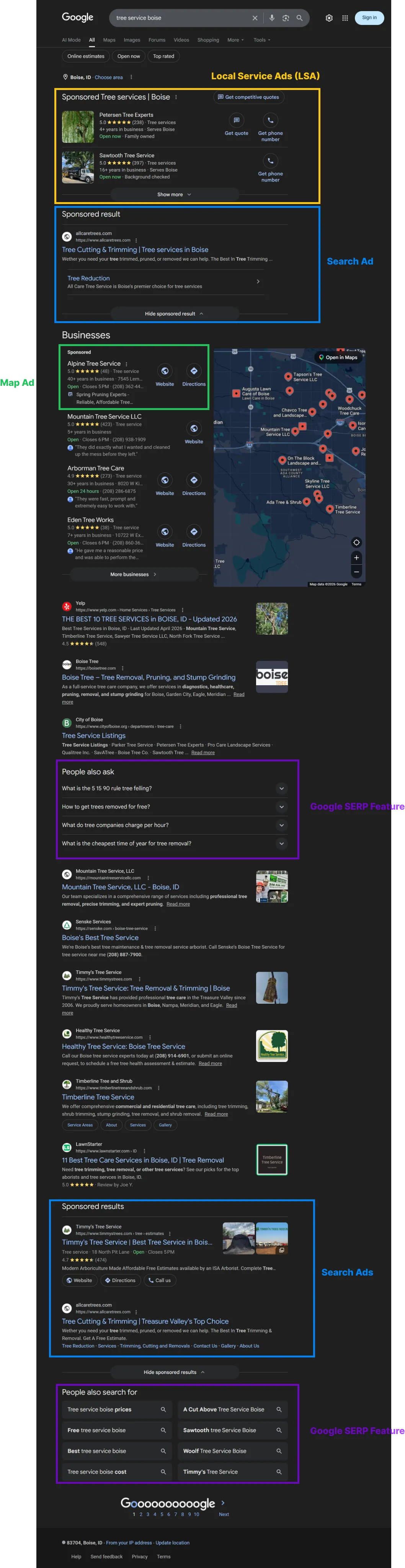
Here's what a tree service SERP typically looks like today:
- Local Service Ads (LSAs) at the very top
- Traditional Search Ads below the LSAs
- Map Pack (often with ads inside it)
- Additional Search Ads scattered mid-page and at the bottom
- Google-owned SERP features like "People also search for" and "Find related products & services" sprinkled throughout
By the time a user reaches a traditional organic listing, they've already scrolled past a half-dozen paid placements and Google-owned modules.
What This Means for Your Tree Service
You can no longer rely on a single channel. Organic rankings are still valuable — they play a meaningful role in AI Search results (AI Overviews, ChatGPT, Perplexity), which I'll cover in an upcoming post — but ranking well organically is no longer enough on its own.
To compete today, tree services need a diversified mix that includes:
- Local Service Ads for top-of-page visibility and pay-per-lead economics
- Traditional Google Search Ads for keyword-level targeting and control
- Map Pack optimization and ads to own the local geography
- Organic SEO as a long-term foundation and an input to AI search
These paid channels are where Google is actively funneling potential customers. Ignoring them means ceding that traffic to competitors who are showing up in those placements.
What to Do About It
If you're a tree service still relying solely on organic rankings, here are three concrete actions worth taking in the next 30 days:
- Claim and verify your Google Local Service Ads profile. This alone gets you into the top placement on high-intent searches and the Google Guaranteed badge.
- Start a small Google Search Ads budget targeting your highest-intent keywords ("tree removal [city]", "emergency tree service", etc.). You don't need a huge budget to learn what converts.
- Audit your Google Business Profile and Map Pack presence. Reviews, categories, service areas, and photos all influence whether you show up in the local pack where a lot of lead volume now lives.
The tree services winning in 2026 aren't the ones obsessing over a single organic ranking. They're the ones showing up everywhere a potential customer might click — LSAs, Search Ads, the Map Pack, and organic — so that no matter where Google sends the traffic, their name is there.
Want help auditing your tree service's paid and organic mix? Get in touch with 208Marketing Group — we specialize in performance-driven digital marketing for local service businesses.